
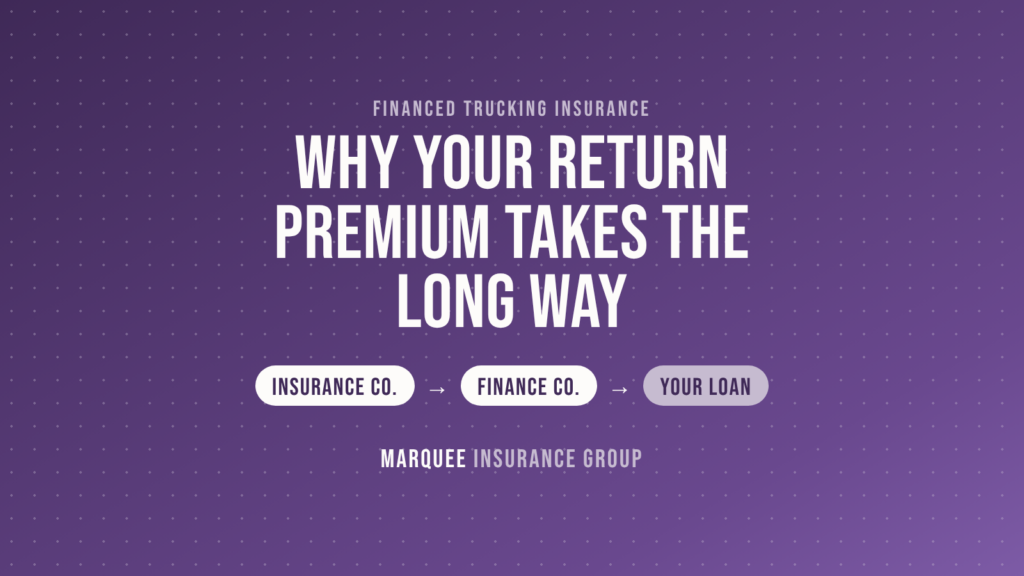
Return Premium on a Financed Trucking Insurance Policy: Why Your Payment Doesn’t Drop Right Away
By Brett Dykes · 8 min read
You sold a truck, an owner operator no longer works for your company. You reached out to your agent and removed the unit from your policy. Then, a week later, your monthly payment comes due and it’s the same amount as before. So it feels like you’re paying to insure a truck you don’t have anymore.
If you finance your trucking insurance, that’s normal. Also, it’s temporary. This guide explains how return premium on a financed trucking insurance policy works: why people finance in the first place, why the credit takes weeks to reach your loan, how it’s applied once it gets there, and why you have to keep paying on time while you wait.
Key Takeaways
✓Return premium (RP) goes to the finance company, not to you or MIG. The finance company paid for your policy up front, so the credit goes back to them first.
✓It takes time. The insurance company has to process the change and send the credit, which commonly takes 30 to 120 days.
✓Keep paying as scheduled. Your installments don’t change until the finance company receives the credit.
✓Open loan? The credit goes to your balance. With several payments left, the finance company generally spreads it evenly across them, so each one gets smaller.
✓Direct bill works differently. On many Progressive, GEICO and most Great West policies, the insurance company bills you itself, so there’s no finance company in between.
01
What Return Premium Is
Return premium (RP) is the unused premium an insurance company credits back when your policy gets smaller mid-term. The most common reason in trucking is removing a power unit or trailer, but any change that lowers your premium can create one:
- Deleting a truck or trailer (see why you need a lease termination or bill of sale)
- Lowering a stated value or dropping physical damage on an older unit
- Removing a coverage, or reducing a limit or radius
- Removing a driver, in some programs
- Cancelling the policy (any return premium may also shrink because of minimum earned premium)
First, the insurance company usually calculates the credit pro rata from the effective date of the change to the end of the term. Some things can shrink it: minimum earned premium (MEP), fully earned fees and taxes, or a discount you lose when the unit or driver comes off. For the basics of how the calculation works, see our earlier post on the return premium process.
What is minimum earned premium? Many trucking policies carry a minimum earned premium (MEP), the part of the premium the insurance company keeps even if the policy cancels early. A common standard is 25% MEP, which equates to roughly 90 days of the policy term. As a result, if a policy cancels before it meets the MEP, the insured may owe the difference. The insurance company sets the MEP, and your policy lists the amount, if any.
02
Why Truckers Finance Their Insurance
Commercial trucking insurance is one of the biggest bills a carrier pays, and most insurance companies want the full annual premium up front. However, very few owner-operators or small fleets want to write that check on day one, so most finance it.
With premium financing, a finance company pays the insurance company for your full policy term. You pay a down payment, then pay the finance company back in monthly installments under a separate finance agreement. As a result, you keep cash in your business for fuel, truck notes, repairs and payroll.
Still, the trade-off is that there are now two contracts: your insurance policy with the insurance company, and your loan with the finance company. That second contract is also the reason return premium works the way it does.
Direct bill vs. financed: On a direct bill policy you pay the insurance company itself, and they adjust your billing when your policy changes. Many Progressive, GEICO and most Great West policies are direct billed. This guide is about policies paid through a premium finance company. Not sure which you have? Check our billing and payment page.
Want a trucking insurance quote with the payment options explained up front?
03
Why Return Premium Takes So Long to Reach Your Loan
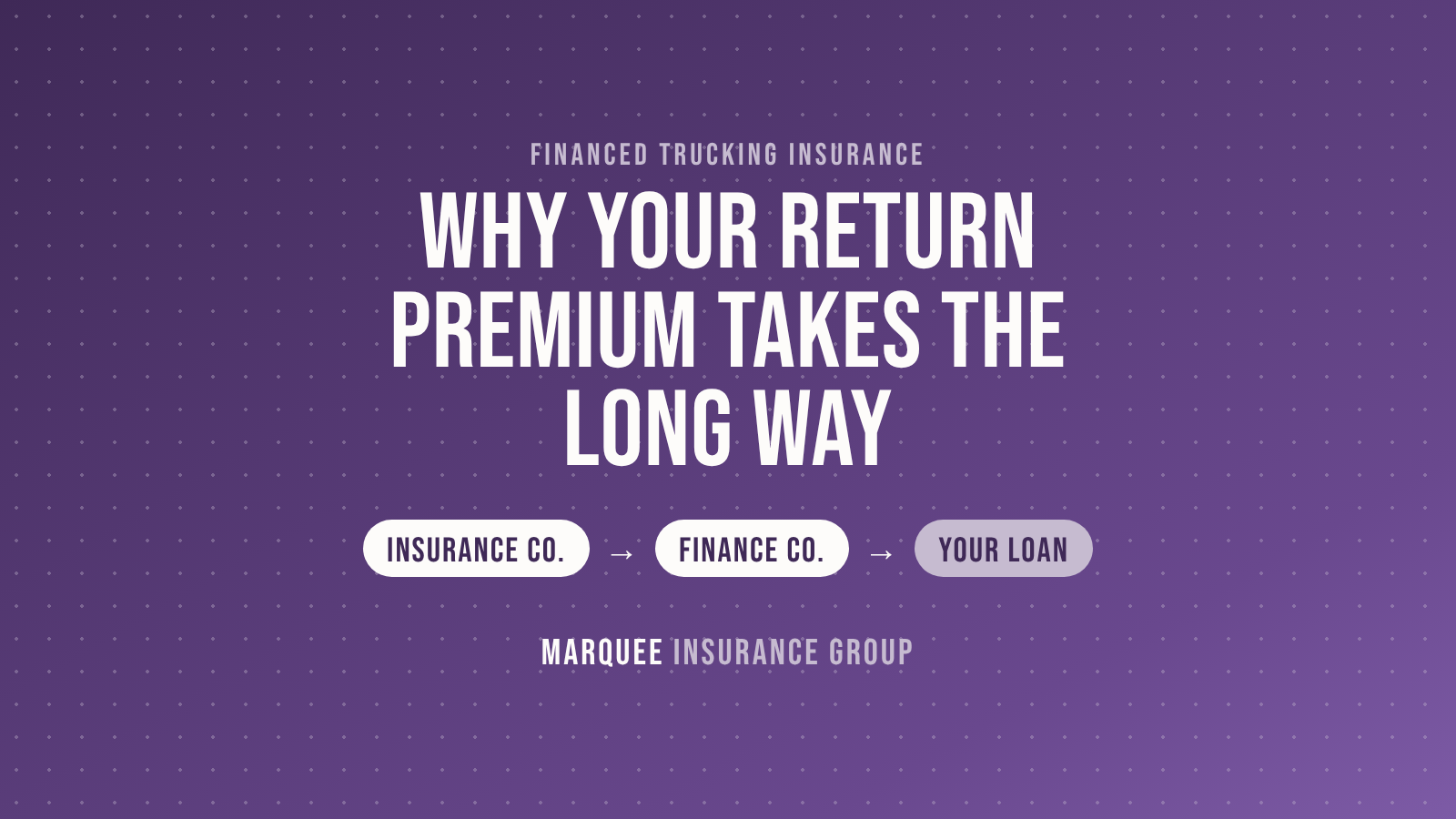
When you remove a truck from a financed policy, the return premium doesn’t come straight to you or to MIG. It has to make a few stops, and each one takes time:
You request the change
First, you send the removal and the documents the insurance company needs. MIG submits it to the insurance company.
The insurance company processes the endorsement
Then underwriting reviews it, issues the endorsement and calculates the return premium as of the effective date.
The insurance company releases the credit
Next, the credit leaves the insurance company. If MIG placed your policy through a wholesaler or managing general agent, it can also pass through them.
The finance company receives it
Only once the money arrives does the finance company apply it to your loan.
Your finance company updates the schedule
Finally, the finance company recalculates your remaining payments and sends you an updated schedule or notice.
From start to finish, that commonly takes 30 to 120 days, and it varies by insurance company and finance company. MIG can follow up. However, the insurance company sets the processing time and the finance company decides when your schedule changes.
04
Why You Keep Paying as if Nothing Changed
In fact, this is the part that frustrates people most. On a financed policy, return premium can’t lower a payment until it arrives. Your finance agreement has a fixed payment schedule, and it doesn’t change until the finance company actually receives the credit. The finance company isn’t ignoring your change. Until the money arrives, there’s nothing to apply.
Here’s how it can look:
| Date | What happens | Your payment |
|---|---|---|
| March 3 | You remove a truck, effective that day | No change |
| March 15 | Regular installment due | Same amount, pay on time |
| April 15 | Regular installment due; credit still in process | Same amount, pay on time |
| Late April | Finance company receives the return premium | Schedule recalculated |
| May 15 | First installment after the credit is applied | Lower payment |
The good news: the insurance company calculates the credit from the effective date of the removal, not from the date it finally reaches your loan. In other words, those weeks of waiting don’t shrink the return premium. You aren’t losing the money, it’s just in transit.
Payment due in a few days? Make it. If you remove a unit right before an installment is due, the credit will not reach the finance company in time to lower that payment.
05
How Return Premium Is Applied to a Financed Policy
Once the finance company has the credit, here’s what generally happens:
- If your loan has an open balance, the finance company applies the return premium to that balance. Therefore, it typically won’t mail you a check while you still owe on the loan.
- If several payments remain, the finance company generally spreads the credit evenly across them, so each remaining installment gets smaller.
- If your loan is already paid off, ask your finance company how they’ll handle the credit under your agreement.
Example: $2,400 credit with four payments left
| Per payment | Payments 7–10 | |
|---|---|---|
| Scheduled installment | $1,850 | $7,400 |
| Return premium applied | −$600 | −$2,400 |
| New amount owed | $1,250 | $5,000 |
Of course, these numbers are just an illustration. Your finance company calculates your actual figures, and some agreements apply credits differently, such as to the last payments first. Your finance agreement is what controls.
Questions about a financed policy before you buy? Talk to a trucking specialist.
06
Pay On Time, Every Month
Waiting on return premium for a financed policy doesn’t change your due date. Because the finance company paid for your insurance with its own money, the finance company has the right to ask the insurance company to cancel your policy if you don’t pay. Also, waiting on return premium doesn’t pause that.
- A late payment can trigger a notice of intent to cancel. If you don’t pay by the deadline on the notice, the finance company can then request cancellation.
- Cancellation can affect more than coverage. If your policy carries a federal filing, the insurance company notifies FMCSA when it cancels, which can put your operating authority at risk.
- Reinstatement may not be possible. Even when it is, there can be late fees, reinstatement fees or a gap in coverage.
Know your due date and who you pay. Your finance company’s name, your account number and your due date are on your finance agreement and your billing notices. A few habits help:
✓Set up autopay with your finance company if they offer it.
✓Put your due date on your calendar, and don’t count on a grace period.
✓Keep your email and mailing address current so you get notices.
✓Open every notice from your finance company. Don’t assume it’s junk.
07
Who to Call With Billing Questions
MIG is your insurance agency, not your finance company or insurance company. MIG doesn’t collect your premium, set your payment schedule or decide when the finance company applies a credit. Instead, your finance company and insurance company make those calls. What MIG can do is point you to the right place:
- Visit our billing and payment page to see who bills your policy and how to pay.
- MIG clients can email billing@marqueeig.com or call (833) RING-MIG.
- Need to make a change? Use our policy change request form.
- For COIs and policy documents, use the client portal.
Our team is available Monday through Friday, 8 a.m. to 5 p.m. ET, during normal business hours. We’re happy to help.
08
More Resources
- The return premium process: how credits are calculated
- Trucking terms glossary: return premium, MEP, premium finance and more
- Removing a truck: why you need a lease termination or bill of sale
- How to read a trucking insurance policy
- Trucking expense calculator
- All MIG resources for trucking businesses
FAQ
Frequently Asked Questions
Why didn’t my payment go down after I removed a truck from my financed policy?
Your premium finance company paid the insurance company for the full policy term up front, so the insurance company has to process the return premium and send it back to the finance company before your payments can change. That can take 30 to 120 days. Until the finance company receives the credit, your installment schedule stays the same and every payment is still due on time.
How is return premium applied to a premium finance loan?
If your finance loan still has an open balance, the finance company applies the return premium to that balance. When more than one payment remains, it generally spreads the credit evenly across the remaining payments, which lowers each one. However, it usually won’t send you a check while the loan is open. Your finance agreement controls exactly how the finance company handles it.
Do I have to keep making payments while I wait for return premium?
Yes. Your finance agreement is a separate contract from your policy, so its payment schedule does not change until the finance company receives the credit. A missed payment can lead to a notice of intent to cancel and, if you still don’t pay, cancellation of your policy.
Is return premium handled differently on a direct bill policy?
Yes. On a direct bill policy you pay the insurance company directly, with no finance company in between. Many Progressive, GEICO and most Great West policies use direct bill, so the insurance company adjusts your billing schedule after it processes the change. As a result, it’s often quicker than a financed policy.
Trucking insurance, from people who do nothing but trucking.
Get a quote online or talk to a MIG specialist about your operation.
GET A FREE QUOTECALL (833) RING-MIG
Our team is available Monday through Friday, 8 a.m. to 5 p.m. ET, during normal business hours. We’re happy to help.
This article is for general information only. Marquee Insurance Group is an independent insurance agency, not a premium finance company or insurance company. Your insurance company and finance company set return premium calculations, processing times and how they apply credits. Your policy and finance agreement govern them, and they can change. Contact your finance company for details about your loan.