
Staged Truck Accidents and Freight Fraud: How It Works and Why It's Getting Worse
On a 14-mile stretch of Interstate 10 outside New Orleans, sideswipe accidents involving 18-wheelers tripled between 2004 and 2017. An LSU statistician calculated the odds of that pattern occurring naturally at 1 in 750 trillion. Investigators eventually uncovered a coordinated criminal network of professional "slammers," attorneys, recruiters, and compliant medical providers that staged hundreds of crashes, filed fraudulent claims, and collected tens of millions of dollars. Trucking companies and their insurers paid the price. This was not a regional anomaly. It was a warning sign for every carrier in the country.
How Staged Accident Schemes Work
Operation Sideswipe, the federal investigation into the New Orleans scheme, exposed an elaborate operation. While the details were specific to Louisiana, the basic mechanics are repeated in different forms across the country. Understanding how these rings are structured is the first step toward recognizing and defending against them.
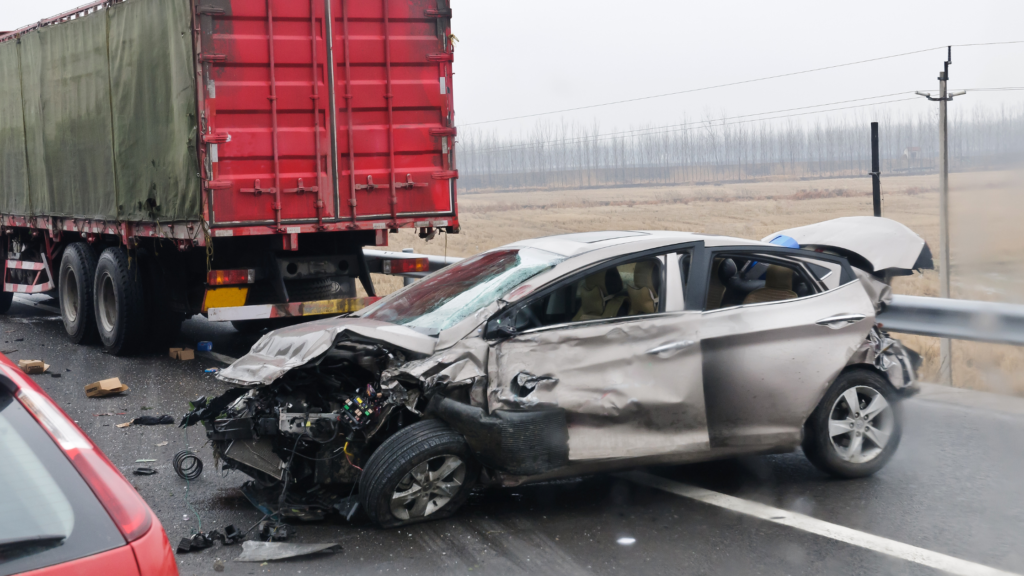
A staged accident ring typically includes a "slammer," the driver who deliberately collides with a commercial truck, and a network of recruiters, attorneys, and medical providers who turn the staged crash into a claim. In the New Orleans case, professional slammer Cornelius Garrison III followed semi-trucks like, as one investigator described it, a lion trailing a wildebeest. He waited for a lane-change signal, accelerated into the truck's blind spot, and made contact. After impact, he moved out of the driver's seat, left the scene, and was picked up by a spotter car. Passengers, often recruited from poor neighborhoods and paid for their participation, falsely claimed to have been driving.
From there, the fraud machine took over. Passengers received unnecessary medical treatment, sometimes including spinal surgeries, to inflate injury claims. Personal injury attorneys filed lawsuits. Insurers, facing the risk of unpredictable jury verdicts, often settled. Payout after payout moved through the network. Randy Guillot, a Louisiana carrier and former ATA chairman whose company was targeted, told investigators there were well over 200 documented staged accidents in the scheme, with payouts exceeding $50 million, much of it coming directly from carriers he knew personally.
Why Commercial Trucks Are the Target
Commercial trucks are uniquely attractive targets for staged accident fraud for reasons that have little to do with how safely they are operated.
First, trucking companies carry high liability limits. Federal minimums require $750,000 in coverage for most carriers hauling general freight, and many carriers carry $1,000,000 or more. Compared with a personal vehicle policy, that creates a much larger pool of potential recovery. Fraudsters follow the money.
Second, the litigation imbalance is real. Plaintiffs' attorneys have learned to portray trucking companies, even small family operations, as deep-pocketed corporate defendants before juries that may already be skeptical of them. Even when a crash was staged, defending a personal injury lawsuit is expensive. The average cost of defending a fraudulent trucking claim can run into the hundreds of thousands of dollars. Many carriers and insurers settle to avoid the risk of a nuclear verdict, a jury award exceeding $10 million, even when the underlying claim is fraudulent.
Third, trucks are everywhere and often operate on predictable routes. Professional slammers learn where trucks slow for exits, merge, or change lanes, then position themselves accordingly. The 14-mile stretch of I-10 in New Orleans East was not chosen randomly. It was a corridor where 18-wheelers moved in patterns that slammers had learned to exploit.
The Nuclear Verdict Connection
Staged accidents are the most overt form of trucking fraud, but they exist on a broader spectrum that also includes inflated claims, exaggerated injuries, and litigation financing by outside investors. The American Trucking Associations estimates that lawsuit abuse drains $529 billion from the U.S. economy annually, roughly $4,200 per household. Trucking is one of the primary targets.
Nuclear verdicts, defined as jury awards exceeding $10 million, surged 52% in 2024 in trucking-related cases. Even when the facts do not support an award of that size, the threat alone can drive settlements far beyond the actual harm. Some plaintiffs' attorneys have shared strategies for pursuing nuclear verdicts across state lines, treating the legal system as a repeatable revenue model rather than a forum for justice.
Congress has introduced bills that would establish federal criminal penalties for staged accidents involving commercial trucks and require transparency in third-party litigation financing, a practice in which hedge funds and private equity firms bankroll lawsuits in exchange for a share of the recovery. Neither bill has been enacted as of mid-2026, but the legislative pressure reflects growing recognition that the problem has reached a scale that requires federal action.
How Carriers Can Protect Themselves
Run Live Dashcams, Front and Rear
After the New Orleans scheme became public, Randy Guillot retrofitted all Triple G Express trucks with live cameras that capture incidents in real time and share footage directly with law enforcement. In a staged accident, dashcam footage showing the other vehicle initiating the collision can be the difference between a settlement and a dismissed claim. Front-facing cameras are important, but they are not enough. Rear-facing cameras capture the approach and impact from behind, while side cameras help address blind spot claims. Footage also matters to insurers. Carriers with dashcam systems are increasingly viewed as lower-risk operations at underwriting, which can help reduce premiums.
Document Everything at the Scene
Train drivers to treat every accident scene as a potential fraud situation, not because every claimant is dishonest, but because the same documentation habits that protect you in a legitimate accident also protect you in a fraudulent one. Drivers should photograph all vehicles involved, the positions of all occupants, skid marks, road conditions, and witnesses. They should note the number of people in the other vehicle before anyone moves, preserve dashcam footage immediately, and contact the carrier and insurer before moving the truck whenever possible. In a staged accident, the gap between what claimants later allege and what the physical evidence shows is often where cases are won or lost.
Report Suspicious Patterns to Your Insurer Immediately
If you or your drivers notice repeated near-misses or unusual vehicle behavior on specific corridors, report it. The New Orleans scheme was flagged by defense attorneys representing trucking companies who noticed that the accident patterns on I-10 were statistically impossible. Trucking-focused insurers have claims data across large carrier pools, which means they can often identify suspicious patterns that individual carriers cannot see alone. Early reporting creates the documentation trail law enforcement needs to investigate.
Work With a Trucking Insurance Specialist
Not all commercial insurers are equipped to handle the litigation environment trucking faces. A specialist who understands nuclear verdicts, staged accident fraud, and the claims dynamics of commercial trucking will structure coverage differently than a generalist insurer. They will also be a more effective partner when a suspicious claim is filed. Coverage limits, umbrella policies, and litigation support all matter when a fraudulent claim lands in your file.
Understand What Your Policy Actually Covers
Staged accident fraud can trigger claims across multiple coverage lines, including liability, medical payments, and legal defense costs. Review your policy with your agent so you understand how your insurer will respond to a suspected fraudulent claim, what documentation they require, and how the claims process works if you believe an accident was staged. Knowing this before a claim is filed is far less stressful than learning it after.
How This Connects to Your Premiums
Staged accident fraud does not only affect the carriers directly targeted. When insurers pay fraudulent claims through settlements or verdicts, those losses are spread across the carrier pool through higher premiums. Accident fraud in Louisiana is estimated to add at least $600 per year to car insurance costs for every Louisiana driver, and the impact on commercial trucking premiums is proportionally larger.
As covered in our guide on how trucking insurance rates are calculated, the rise of nuclear verdicts is one of the primary market forces driving premium increases across the industry. Staged accidents feed directly into that dynamic.
At Marquee Insurance Group, we work with carriers to make sure coverage is structured for the real litigation environment trucking operates in today, not the one that existed a decade ago.
Questions about how your coverage is structured for the current litigation environment? The MIG team is here.
Talk to MIG