
HOS Violations and ELD Compliance: What to Know in 2026
HOS VIOLATIONS AND ELD COMPLIANCE
Hours of service violations and ELD non-compliance are two of the most common and most costly compliance problems in trucking. Here’s what every driver and fleet manager needs to understand about the rules, the enforcement landscape, and what a violation actually costs you.
WHY HOS AND ELD COMPLIANCE MATTER MORE THAN EVER
FMCSA enforcement around hours of service has never been more precise. Loopholes in FMCSA’s previous ELD vetting system made it easier for companies to register non-compliant devices or re-register devices that were previously revoked. Stricter enforcement and more thorough investigations are driving a new level of accountability.
The stakes are real. A single HOS violation carries a civil penalty of up to $16,000 per offense. Egregious and willful violation —including ELD tampering, falsifying records of duty status, and operating a deregistered device — carry maximum penalties up to $16,000 per violation under 49 USC 521 (b)(2)(B). Serious violations can trigger penalties up to $125,000, out-of-service orders that halt operations immediately, and, in worst-case scenarios, complete revocation of operating authority.
FMCSA enforcement activity increased by 28% between 2025 and 2026, signaling a heightened focus on regulatory compliance. During the 2025 CVSA International Roadcheck, 1,076 drivers were placed out of service for hours-of-service (HOS) violations in just 72 hours. While the final results of the 2026 Roadcheck have not yet been released, preliminary reports suggest a material increase in out-of-service rates compared to prior years. Enforcement is intensifying, and the message is clear. ELD tampering will not be tolerated.
THE FOUR HOS LIMITS
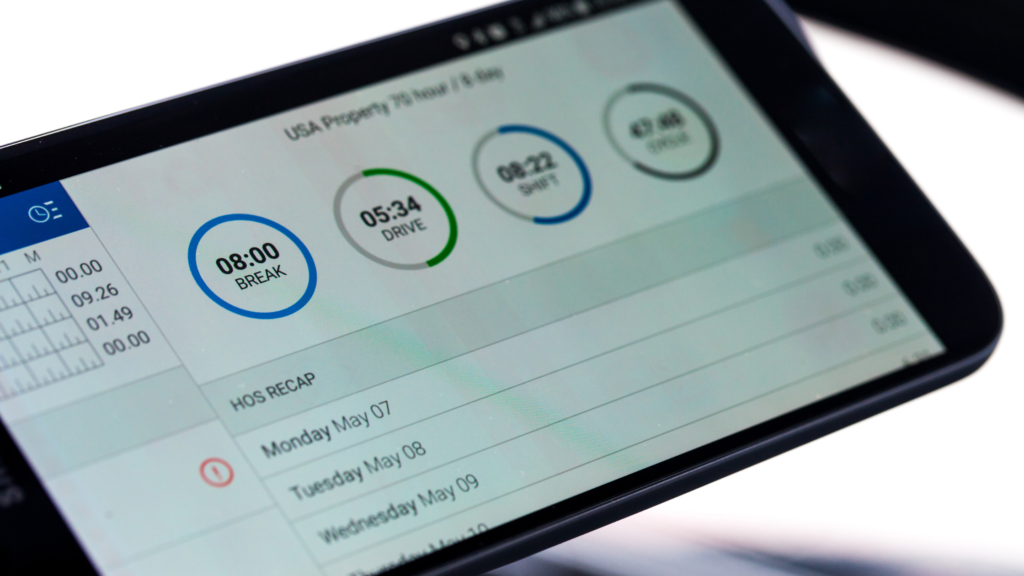
There are four core HOS rules under 49 CFR Part 395 that apply to property-carrying CMV drivers. All four must be satisfied at the same time. Each is a separate violation. Operational requirements such as delivery times are irrelevant to these regulations.
01
The 11-Hour Driving Limit
A driver may drive a maximum of 11 hours after 10 consecutive hours off duty. Once a driver hits the 11-hour mark, they must go off duty, regardless of where they are or what’s left on the delivery window.
02
The 14-Hour On-Duty Window
A driver cannot drive beyond the 14th consecutive hour after coming on duty. This window cannot be extended by taking breaks. Once the clock starts, it runs. A driver who clocks in at 6am cannot drive past 8pm, even if they spent hours of that window on breaks or non-driving work.
03
The 30-Minute Break Requirement
Drivers must take a 30-minute break after 8 cumulative hours of driving time. The break must be taken in the sleeper berth, off duty, or in any non-driving status. It cannot be taken while the truck is moving.
04
60/70 Hour Limit
Drivers may not drive after reaching 60 hours on duty in 7 consecutive days, or 70 hours in 8 consecutive days, depending on which schedule the carriers operate. The weekly cap resets after 34 or more consecutive hours off duty.
ELD REQUIREMENTS IN 2026
Most commercial fleets operating vehicles with a GVWR of 10,001 pounds or more are required to use FMCSA-certified ELDS. That device must be on the current FMCSA-registered ELD list, which changes throughout the year as devices are added and removed.
This is not a theoretical concern. In late 2025, FMCSA removed PSS ELD, Black Bear ELD, and RT ELD Plus from the registered list, with a replacement deadline of February 7, 2026. Carriers still using those devices after that date are out of compliance and at risk of HOS/ELD violations up to $19,246 per violation. In early 2026, four additional devices were removed with March 2026 replacement deadlines.
FMCSA does not send direct notice to individual carriers when a device is removed. The registered list at eld.fmcsa.dot.gov is the only authoritative source. Checking your device against that list monthly is the standard that keeps you out of trouble.
ELD Malfunction Protocol: When an ELD malfunctions, drivers must revert to paper logs immediately and notify their carriers. The carrier has an 8-day window to repair or replace the device. This protocol must be documented in writing and acknowledged by all drivers in advance, not assembled at the roadside when it's already a problem.
THE MOST COMMON HOS VIOLATIONS
Some of the most common violations are often dismissed because they seem minor, include failure to make required log annotations, failure to certify daily records, and unresolved unassigned driving events. Each of these carriers severity weights of 1 to 3 in the CSA scoring system. They look harmless individually.
But FMCSA’s Safety Measurement System aggregates violations across all inspections within a 24-month window, applies time decay weighting that makes recent violations count three times heavier than violations from 24 to 36 months ago, and calculates that carrier’s percentile within its peer group. A pattern of low-weight administrative violations across multiple drivers, none of which individually look alarming, can move a carrier’s HOS Compliance BASIC score toward the 65th percentile intervention threshold, where FMCSA begins targeted investigations.
The most frequently cited HOS violations at roadside inspections include:
- Operating beyond the 11-hour driving limit
- Operating beyond the 14-hour on-duty window
- Failure to take the required 30-minute break
- Exceeding the weekly 60/70-hour limit
- ELD record falsification or tampering
- Failure to retain supporting documents such as bills of lading, fuel receipts, and toll records
- Unresolved unassigned driving events
As of Q1 2026, FMCSA enforcement personnel cited ELD tampering and falsification violations in 10% of all driver out-of-service orders during the previous year’s International Roadcheck. Inspectors are specifically trained to look for these; they are not rare findings.
WHAT A VIOLATION ACTUALLY COSTS
The financial impact of an HOS violation goes well beyond the civil penalty on the citation. Every violation recorded at roadside flows into FMCSA’s CSA system, where the long-term damage accumulates because CSA scores affect insurance premiums, broker qualification, and shipper access for a full 24 to 36 months after the original incident.
$5,000 to $20,000
Estimated total compounding cost per serious HOS/ELD violation when factoring in civil penalties, out-of-service revenue loss at approximately $264 per day, towing costs, and the downstream insurance and CSA score impact.
A major HOS violation — 7 CSA points — can push a carrier toward investigation thresholds that trigger FMCSA compliance reviews. Those reviews examine all eight compliance areas independently, and a gap in one area triggers deeper investigation across all others.
HOW THIS AFFECTS YOUR INSURANCE
Underwriters look at CSA scores when pricing commercial trucking coverage. A carrier with a clean HOS Compliance BASIC is a different risk profile than one trending toward the 65th percentile intervention threshold — and that difference shows up at renewal. Fleets with HOS violations on record typically face higher premiums, more restrictive policy terms, and, in some markets, difficulty finding coverage at standard rates.
Carriers that maintain clean records, run compliant ELDs, and document their HOS protocols are better positioned when renewal comes around. At Marquee Insurance Group, we work with carriers of all sizes to make sure your coverage reflects the compliance work you’re putting in.
WHAT TO DO RIGHT NOW
- Verify your ELD is on the current FMCSA registered list at eld.fmcsa.dot.gov
- Make sure your ELD malfunction protocol is documented and driver-acknowledged in writing
- Review your CSA BASIC scores quarterly at safer.fmcsa.dot.gov
- Train dispatchers on the 14-hour window — scheduling pressure is a leading cause of HOS violations
- Audit unassigned driving events monthly and resolve them before they become violations
- Retain supporting documents for at least 6 months: bills of lading, fuel receipts, toll records